
Autosteer for combines: what fits, how the install goes, what you get
Yes, the FJD AT2 kits steer combines, and they do it well. A combine is a rear-steer machine, so the setup is different from a tractor: the vehicle type is set to harvester, the steering is set to rear wheel, and most combines run without a wheel angle sensor at all. The motor goes on the steering column, the receiver goes on the cab roof, and you run a full header all day and all night.
Ask about your combine Call or Text (580) 394-0089Why combines are different from tractors
- They steer from the back. The rear wheels turn, so the machine swings its tail to change heading. The software knows this when the vehicle type is set to harvester and steering is set to rear wheel. It leads the line further ahead and damps the correction so the header does not hunt.
- Most run without a wheel angle sensor. On a front-steer tractor the sensor on the axle tells the system where the wheels are pointed. Rear-steer combines steer straight on heading alone with the right control model and heading stability turned on. We set those values for you.
- The receiver sits a long way from the steering axle. The distance from the roof receiver back to the rear axle goes into the setup. Get it right and the header edge lands where the screen says it will.
- Speed matters more. A combine at 4 to 6 mph with a 40-foot header does not want quick corrections. The settings that make a tractor crisp make a combine wag. Combine settings are their own recipe, and we have it.
Combines we put kits on
A sample. If yours is not here, call us with the model and a photo of the steering column; the bracket and spline adapter are what we need to match.
| Brand | Models | What we install |
|---|---|---|
| John Deere | 9570, 9660, 9770 STS; S660 to S790; older 9500 and 9600 | AT2 motor kit on the column. Receiver on the cab roof. |
| Case IH | 2588, 7088, 8120, Axial-Flow 30 to 50 series | AT2 motor kit. The 2588 is rear-wheel steer, set that way in the software. |
| Gleaner | R65, R76, S series | AT2 motor kit. The R76 takes the same spline adapter as a Massey 9895. |
| Claas | Lexion wheeled and tracked, Jaguar choppers | AT2 motor kit, no wheel angle sensor on the tracked Lexion. |
| New Holland | CR and CX series | AT2 motor kit. Same cab family as Case IH on the newer machines. |
What a full header is worth
A 40-foot header run by hand usually leaves a foot or more of overlap on every pass so you do not leave a strip. That is two and a half percent of your acres cut twice: fuel, hours and wear for nothing. Autosteer puts the header edge on the last pass within an inch or two, so you cut the width you paid for. At night, in dust, in a crop that all looks the same, the difference is bigger than the math.
What goes on the combine
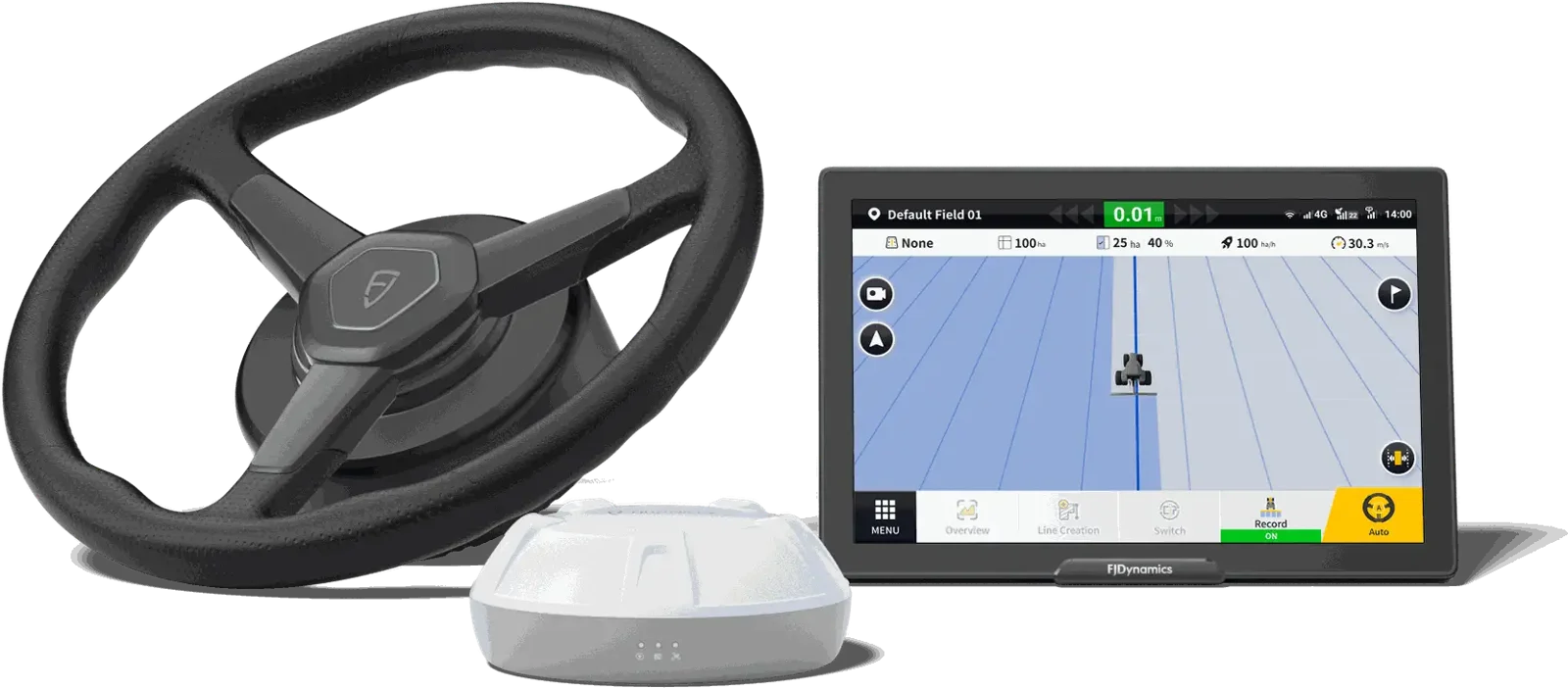
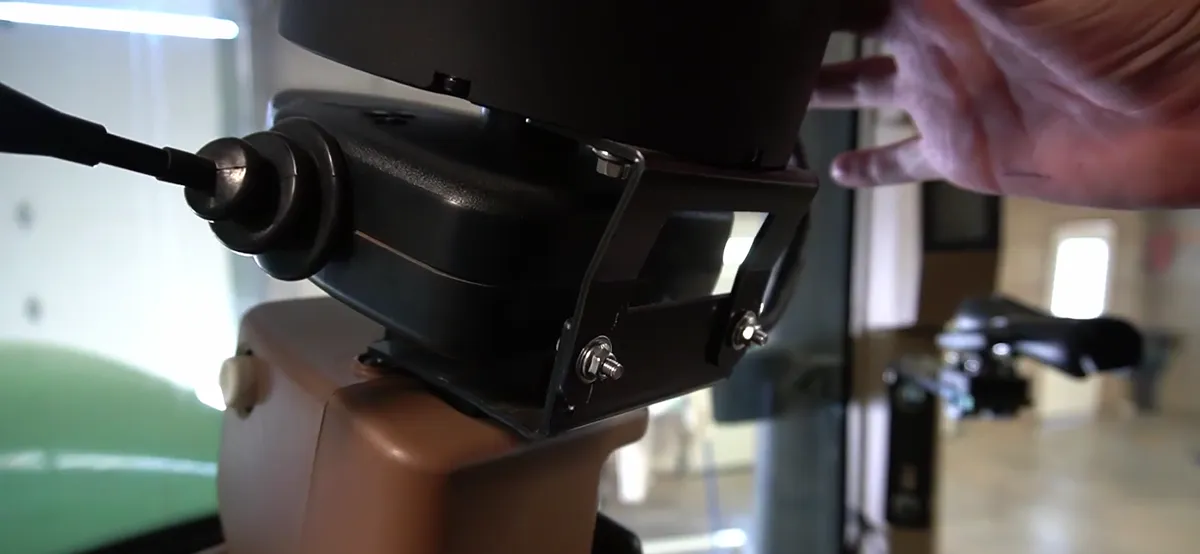
- The motorized steering wheel on the column, with the spline adapter and bracket matched to your cab.
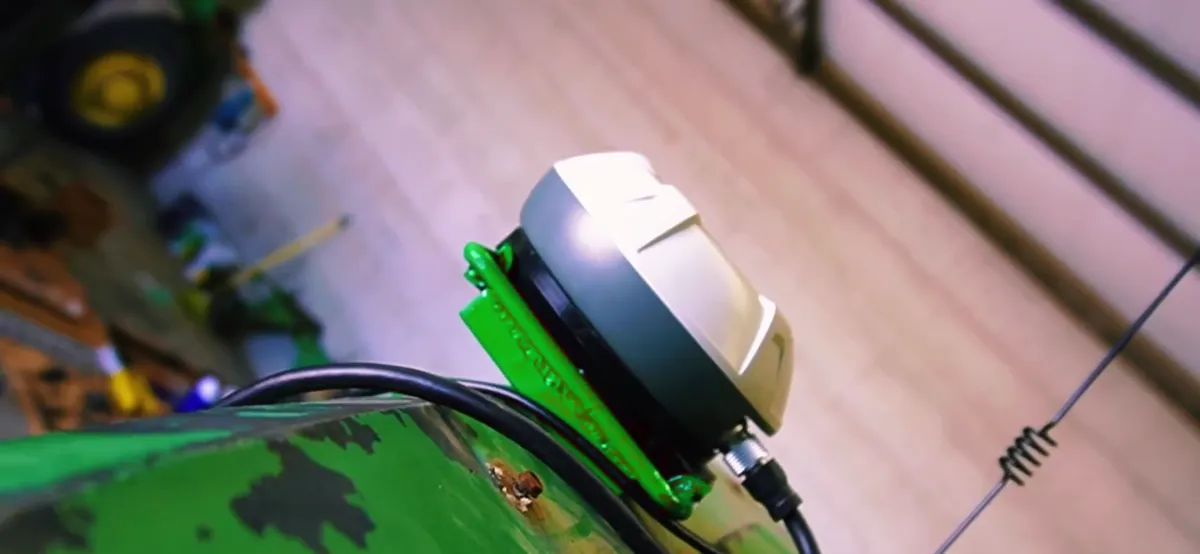
- The receiver on the cab roof, with the RTK correction over cellular or radio.
- The display where you want it. The 10-inch on the AT2 Lite and AT2, 12-inch on the AT2 Max.
- A fused 12-volt lead to the battery. No combine wiring touched.
What goes on the column
Which FJD kit for a combine
Almost always the electric motor kit. The AT2 Lite is steering only and plenty for a combine. The AT2 and AT2 Max make sense if the same system will run ISOBUS implement control on the planting tractor the rest of the year. A combine with a factory steering valve can take the AH2. The Autosteer for Tractors page compares them side by side.
- Make, model and year of the combine
- A photo of the steering wheel and column from the seat
- Whether it ever had a dealer guidance system on it
- Which tractor, if any, the kit will move to after harvest
- Your farm location so we check RTK coverage
Common questions
Does a combine need a wheel angle sensor?
Usually not. Rear-steer combines with the right settings steer straight without one. Our standard combine setup uses no angle sensor, and we have run it that way on Deere STS, Lexion and Gleaner machines. It does not hurt to add one, and on a few machines it helps, but it is not required.
Which combines have you put kits on?
John Deere 9570, 9660 and 9770 STS and the S-series, Case IH 2588 and 8120, Gleaner R65 and R76, Claas Lexion including tracked machines, New Holland CR, and self-propelled choppers. Send us the model and we will tell you the bracket and spline adapter it takes.
Can I move the kit between the combine and a tractor?
Yes. Harvest is a few weeks a year, so a lot of farmers buy the extra column parts and move one system between the combine and the planting or spraying tractor. The display, receiver and controller unplug and go along.
How accurate does it hold at harvest speed?
A rear-steer machine responds slower than a front-steer tractor, so the software leads the line a little further ahead. Set up right, a combine holds the header edge within an inch or two at normal harvest speeds. We set it up with you on the phone the first time.
Do I need RTK on a combine?
RTK gives you the same line every pass and lets you pick the header edge up exactly. Some farmers run a combine on PPP or WAAS because they are not planting on the lines later; the AT2 supports all three and switching between them is a menu setting. See RTK vs WAAS for the plain-language version.
Does it run the header or the yield monitor?
The autosteer kit steers. Yield mapping is a separate FJD product, the AYM yield monitor, which uses the same display. We can quote both.
What about a combine that was guidance-ready from the factory?
Newer combines with a factory valve can take the AH2 hydraulic kit, which plugs into the valve and leaves the steering wheel stock. Most combines we see get the motor kit because it moves to a tractor after harvest.
More on auto steer
Autosteer for Tractors · Is my tractor steer-ready? · Older tractors · Articulated 4WDs · Combines · Sprayers · Swathers · RTK vs WAAS · What RTK costs to run · FJD AT2 vs Wheelman · FJD AT2 · AT2 Max · AS2 steer-ready · AH2 hydraulic · GEODNET RTK · John Deere · Case IH · New Holland · Kubota · Massey Ferguson · Reviews
Published 10/13/2026 by Deep Sand Tech, Lone Wolf, Oklahoma. Written from our own installs and support calls, not from a brochure.